Scienvera · research-engineering studioEst. 2024 · Bioinformatics · Software
Research → software

We turn research into software you can trust.

Scienvera is a small research-engineering studio. We build our own AI researcher, a tool that cites every claim against the literature, and we turn scientists' algorithms into real applications: desktop with Tauri and Qt, web and backend with Spring, deployed on cloud.

Our flagship product · tools.scienvera.com
Does metformin reduce sarcoma recurrence?
SUPPORTED · 6 sources

Evidence is mixed but trends positive: three cohort studies report reduced recurrence; one RCT shows no significant effect.

[1]Metformin and cancer recurrence: a meta-analysis2023
[2]Adjuvant metformin in soft-tissue sarcoma (RCT)2021
  Desktop · Tauri / Qt
  Backend · Spring
  Models · cloud · k8s
The Scienvera Researcher · our own product

A research assistant that refuses to make things up.

We built it for ourselves first. Proof of how we work. It began as a citation finder and claim-checker; every query runs against the academic record, so what you get back is traceable, not plausible-sounding.

01

Cited answers

Ask in plain language. Every sentence links to the paper it came from. No source, no claim.

02

Claim verification

Paste a statement. Scienvera cross-references PubMed and returns supported, unverified, or contradicted, with evidence on both sides.

03

Literature search

Filter by venue, year, and study type. Surface the primary sources behind a topic in seconds, ranked by relevance.

Models built for the clinic, not the demo.

Deep-learning research in computational oncology: multi-omic integration and cancer subtyping, evaluated on real patient cohorts.

PROJECT 01
· Transformer· multi-omic· autoencoder

Multi-omic autoencoder for sarcoma patient stratification

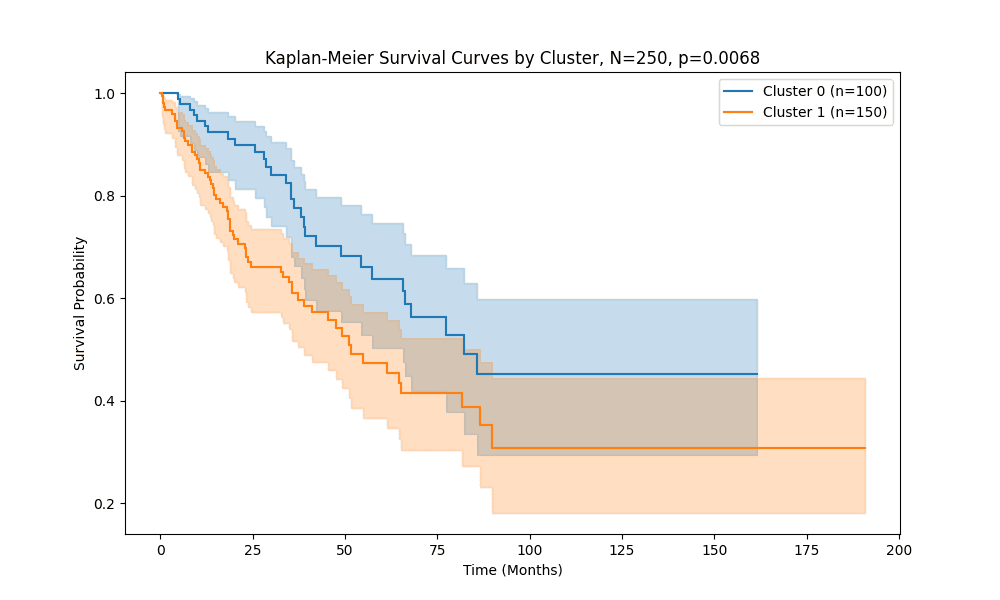
A Transformer autoencoder integrates RNA-seq and 450k DNA-methylation data into a shared latent space. Unsupervised clustering of that space splits 250 patients into two risk groups with significantly different overall survival, a prognostic signal single-omic analysis misses. The separation holds across 100 bootstrap runs (mean ARI 0.92) and stays significant in multivariable Cox regression (HR 1.99, adjusting for age, sex, and histology).
Cohort
n = 250 sarcoma patients
Result
log-rank p = 0.0068 · HR 1.80
Kaplan–Meier overall-survival curves for the two AI-derived clusters (N=250), consensus log-rank p=0.0068.
Kaplan–Meier survival by AI-derived cluster (N=250, p=0.0068)
PROJECT 02
· cross-attention· gating· multi-modal
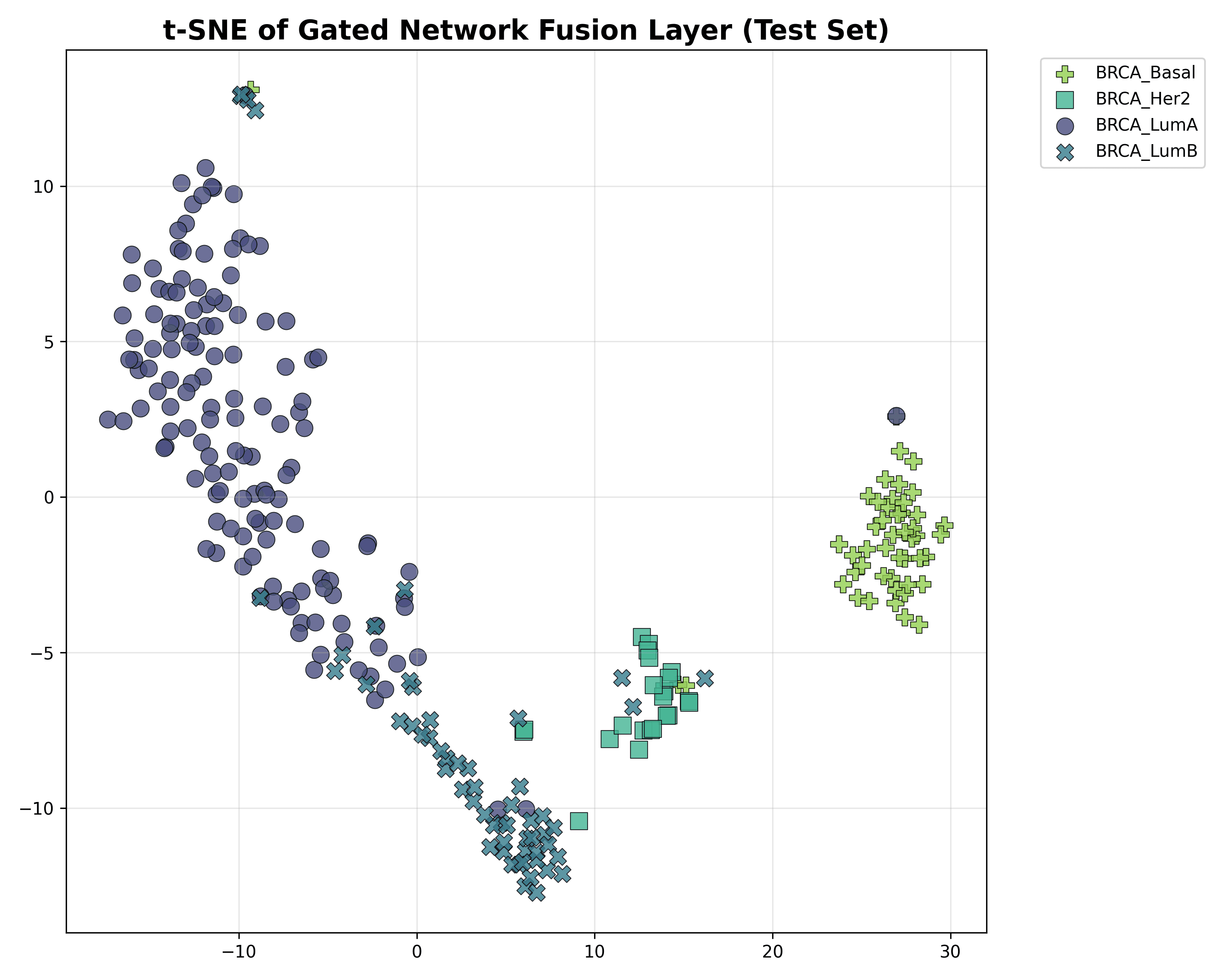
t-SNE of the gated fusion layer on the test set, showing clean separation of the four BRCA subtypes.
t-SNE of gated fusion layer, test set (N=267)

Gated cross-attention network for breast cancer subtyping

A gated cross-attention mechanism fuses gene-expression and mutation features: each modality attends to the other while a learned gate controls how much each contributes. On a held-out test set of 267 patients it classifies the intrinsic molecular subtypes (Luminal A/B, HER2-enriched, Basal) at 92.8% accuracy, and the learned fusion layer separates the subtypes cleanly in t-SNE.

Task
Subtype classification
Accuracy
92.8% · N = 267 test

Selected publications & preprints

We publish our methods and release code. Links resolve as preprints and repositories go live.

2025
Transformer-based Multi-omic Autoencoder for Sarcoma Patient Stratification
Scienvera Labs · preprint · computational oncology
2025
Gated Cross-Attention Networks for Breast Cancer Subtype Classification
Scienvera Labs · preprint · multi-modal deep learning

You have the science. We make it software.

Most research algorithms never leave the notebook. We take a method or model and turn it into an application a lab or clinic can actually use, the same way we built our own.

From algorithm to application

01

Give us a method or model; we deliver a tool your users can run. Desktop and clinical apps with Tauri and Qt, web and backend with Spring.

Tauri · Qt · Spring

Bioinformatics modeling

02

Deep-learning models for genomics and multi-omic data: stratification, subtyping, and integration, from prototype to validation.

PyTorch · multi-omic · clinical

AI & literature intelligence

03

Citation-grounded answer systems, claim verification, and retrieval over scientific corpora. The engine behind tools.scienvera.

RAG · PubMed · evaluation

Cloud & deployment

04

Containerized deployment on Kubernetes, CI/CD, and observability, so models and services ship and stay shipped.

Docker · k8s · CI/CD

What we're working on.

Multi-omic integration
  • Fusing RNA-seq, methylation & mutation signal
  • Attention and gating to weight each modality
Prognostic subtyping
  • Unsupervised, survival-anchored risk groups
  • Bootstrap-stable clusters, not one-off runs
Clinical translation
  • Validation on external patient cohorts
  • Models interpretable enough to trust

The people behind the platform.

Founder
Founder
ML & Bioinformatics

Builds the models and the platform end to end: research, backend, and infrastructure.

[ not now ]
Not hiring right now

The team is closed for now, with no open roles. This is a solo effort while the research and platform take shape.

Build on evidence,
not guesswork.